Thursday, July 4, 2013

Celebrating the Fourth

After he signed the Declaration of Independence, John Adams wrote his wife, Abigail, a letter predicting that this momentous event would be remembered and celebrated as a great festival for generations:
It ought to be solemnized with Pomp and Parade, with Shews, Games, Sports, Guns, Bells, Bonfires and Illuminations from one End of this Continent to the other from this Time forward forever more.

Photo by Dan Holm
I’m sure Adams would be pleased to know we’ve taken his advice.  We celebrate the 4th (not the 2nd, despite what Adams said) with picnics and pool parties and fireworks.
   
But, of course, Independence Day is about more than that.  It’s about how a brave, audacious people stood up to the mightiest power of the age to claim their inalienable rights.

It’s easy to take the success of our democracy for granted.  We forget how hard it is to make this form of government work.  Democracy is about endless discussion and compromise.  It’s about finding balance between public and private, state and federal, the state and the market, the needs of the individual and the needs of the many.

By its nature, our form of government is frustrating, tedious, and fragile.  But, if the founding fathers (and mothers) had wanted it to be easy, they’d have given us a king instead of a constitution.  

As Ben Franklin said, they gave us: “A republic, if you can keep it.”

We’ve kept it for 237 years so far.  While we sing patriot songs and watch the rockets light the sky, we ought to commit ourselves to work together to protect our rights and our privileges, to find the balance, no matter how hard it may seem, and to ensure our laws and practices guarantee ALL a chance for life, liberty and the pursuit of happiness, from this time forward and forever more.

Tuesday, July 2, 2013

Feed Your Head: Why Your Brain Craves A Good Story

Without a good story, beautiful prose is just empty calories . 

Lisa Cron examines this idea in her book WIRED FOR STORY, one of the best writing books I've read in a long time.

See it on Goodreads
I love Cron's book because it talks about how recent breakthroughs in neuroscience help us understand what our brains are hungry for and how writers can use this knowledge to tell better stories. 

I'm fascinated by brain science.  I love to know how the mind works, why people act the way they do, how the structure and mechanics of our brains influence the way we act and think.  Applying it to writing is the next logical step.

It's all in your head


In her book, Cron asks, why do humans naturally crave something as ethereal and seemingly unimportant as stories?  The answer: survival.  We evolved to love stories because they help us simulate and learn from experiences, without actually having to live through them.  So if we're ever captured by pirates, chased by flying monkeys or lost in the Sahara desert, we'll know what to do.  While reading or listening to a story, subconsciously, we continuously ask ourselves, what would I do in this situation?

Like a harrowing ride on an upside down roller coaster, stories provide the chills and spills and adrenaline of a threatening situation, with none of the risks.  We play out the scenario in our minds, so we won't need to face a charging elephant stampede to anticipate how we might react.  

It's especially true in the social realm.  We need to know what other people might be thinking.  Why do they act the way they do?  How do I deal with them?

The connection is so subconscious, we aren't even aware of it.   We feel what the protagonist feels and experience the story, just as though it's really happening.

In order to engage this hard-wired response in our readers, writers have to tell the right kind of stories.

 Now that's a good story


A good story triggers our desperate need to know what happens next.  Our curiosity is aroused, and the mechanisms in our brains drive us to find the answers.  And when we finally do, our brains reward us with a little charge of dopamine.

Haven't you felt it?  You're reading a fast- paced thriller or a heart-breaking love story and feel compelled to know how it ends.  You skip lunch, stay up late, neglect your dog, just to read a little bit more. And when you finally figure out who committed the crime or learn the secret that's keeping the loving couple apart, it feels great

That's the reaction every writer is after.  A story that gets into a reader's head and rewards her with the "aha" moment she's craving.  To achieve this, the first thing a writer has to do is to make the reader care.

Make something happen


Something must be at stake from the first page.  No matter how exquisite the descriptions or scintillating the dialogue, if there's nothing at risk, there's little reason to pay attention.

Cron says, a story is the telling of events that affect someone in some way and causes them to change as a result.   "Not only must something be happening, but there must be a consequence we can anticipate."

A story with no consequence is flat and uninteresting.  The higher the stakes, the more the reader is engaged. 

To achieve this, someone in the story has to want something.  To find the hidden treasure.  To catch the bad guys.  To win the bowling trophy.  To earn a father's approval.  To save the world.  Something. Even in a "literary" novel, characters must have a goal.

Figure out what the main character wants and create obstacles to keep her or him from acheiving it and you'll have the reader eating out of your hand.

Friday, June 28, 2013

Cruising Altitude 2.0: WRiTE CLUB - Last Call

Get ready to rumble!

Sunday is the last day to enter DL Hammons's awesome head-to-head writing contest, WRITE CLUB.
Photo by Dan Holm
The contest features twice-weekly bouts where the winners advance to the play-offs, leading ultimately to a single champion.  To enter, you just submit a 500-word writing sample under under a pen name. A panel of ten celebrity judges (agents and writers and such) will read the entries and pre-select 32 of the best writing samples to climb into the ring, and face off, two at a time. Winners are chosen by the blog's readers.  Check out DL's blog, Cruising Altitude for more info.  Good luck!  I hope to see you in the ring.


Sunday, January 20, 2013

To B of A Who Wants to Take Our House

To my Dear Friends at Bank of America:

My family says that it's futile to appeal to the feelings of a cold, monolithic, bureaucratic, multinational corporation, but I know they're wrong.  The Supreme Court, in its infinite wisdom, said that corporations are people too.  That's how I know you'll want to sympathize with my sad story.

(It's true we didn't originally pick you as our mortgage company but please, don't let that hurt your feelings.  Our mortgage was sold to Countrywide and then sold to you, but that doesn't matter.  In America, we all have to deal with the servicer we're sold to.)

There are many reasons we are in this situation, and since you and I have been talking for a while, you already know most of it, so I won't bore you with all the details. Suffice to say, it all started way back in 2008, right before the housing bubble popped and slimed the residue all over our economy.  My husband and I suddenly found ourselves without jobs.

This is where you came in.  After struggling mightily to keep up with our mortgage payments we went to you for help.  I know how badly you wanted to be there for us in our time of need.  Unfortunately, you told us we had to be three months behind in our payments before you could help.  So we got behind.  And then we got further and further behind.  You finally did help, a year later. You came through with a modification that RAISED our payments.  I must tell you, though you meant well, it wasn't that much help.  Then, there was the modification you suddenly sent us that you later refused to acknowledge.  Oh, I'm not blaming you.  You had us talk to all sorts of different people who tried to help and afterwards none of them returned our calls.  But it's okay.  I know they were busy.

So now, 4 1/2 years later, you have your heart set on taking our house.  I'm sorry we have to quarrel, but that's how it is sometimes with friends. I know if you really think about it and search your heart, you'll change your mind.  Taking our house would mean taking the orange tree that I planted in the backyard.  I just picked a basketful of fruit and the oranges are so sweet.  It would mean taking away the sunny window where my African violets bloom best.  You should see them, bursting with blossoms of bright pink and deep velvety blue.  And taking our house would mean taking away the rose bushes I planted--one in each color: pink, red, yellow and orange.  I chose them because they had names like Burning Desire and Cardinal Song. What about the fireplace where our children waited for Santa?  We were hoping our grandchildren might do the same some day. And the lovely bay window we installed in the front bedroom and the brushed pewter chandelier we saved up to buy that hangs over the kitchen table?  I know you wouldn't want to take all that away from us.  After all, corporations are people too.

Thank you for taking the time to listen to my story.  I wait hopefully for your response.

Sincerely,

A customer


Monday, October 15, 2012

Riding the World's Shortest Railway

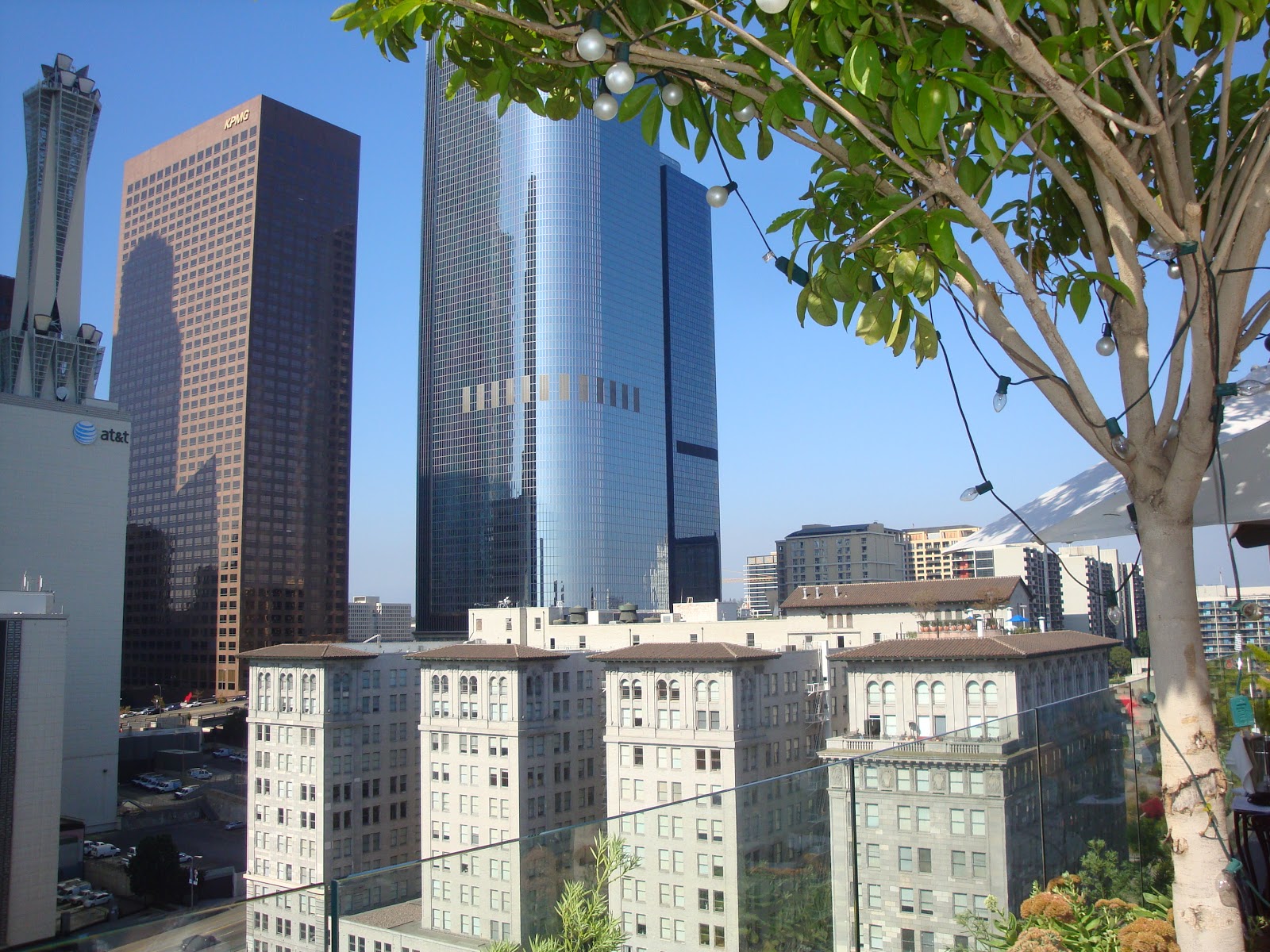
Last weekend, my family and I drove into downtown LA to celebrate my birthday.  I had lunch at Perch, an awesome rooftop restaurant, curtsey of my awesome daughter.  And we took a ride on Angel Flight.


"For just 50 cents (or 25 cents for holders of valid Metro Passes) you can board one of the two orange and black incline railway cars and ride "The Shortest Railway in the World." This funicular dates back to 1901, when Bunker Hill was one of the most fashionable neighborhoods in Los Angeles and the cars, Olivet and Sinai, ferried prominent citizens up and down the steep slope between Hill and Olive streets. The beloved landmark was dismantled for "urban renewal" of the area in 1969. In the early 1990s, the Railway was refurbished and relocated a half-block south, reopening adjacent to California Plaza in 1996. As short as it is (298 feet), Angels Flight® is an essential Los Angeles experience."


To learn more about this historic railway, visit their website.

Monday, September 3, 2012

GUTGAA: Getting to Know Me

Deana BarnhartGood day, friends and cyber-neighbors!

I'm taking part in the Gearing Up to Get an Agent Blog Hop  or as it's fondly called in writer circles, GUTGAA, now happening on the amazing Deana's Barnhart's Blog.  This is a six-week event, culminating in agent pitch contest and a small press editor pitch contest.  So, in the interest of full disclosure, transparency and getting to know me better, I shall now bear my soul.  Well, not really.  I'll just answer a few questions.

-Who are you?

My short bio is to the right.  But I will add, that I grew up in Chicago and currently live on the west coast.  For my day job, I'm a documentary researcher and production coordinator.  I love writing and I love researching and when you write novels, you get to do a lot of both.  Win-win!

-Where do you write? 

Mostly in the tiny cramped little room that used to be our son's bedroom, and is now known as "the office."  It's messy and dusty, filled with bookshelves, my husband's photo equipment, and papers waiting to be filed.  It's cluttered, because to keep the rest of the house clean, we dump all the junk in here.  As usual, you can't see my desktop right now.  My husband's desk, where he makes his own magic happen, is to the left of me.   There's a window to my right that looks out on the path that leads to my front door, where I can watch for delivery people and advertisement flyer distributors.  My family wonders how I can spend so much time in this room, and I remind them that, while my butt's in the chair, my imagination is carrying me off to faraway fantastic places.

-Favorite time to write?

Anytime, really.  My life's too chaotic to stick to any kind of schedule. Morning's probably best--but not too early.  I need to be fully awake before the creative juices start circulating.  But not too late or I burn out. 

-Drink of choice while writing? 

Hot Tea.  English Breakfast usually.  And I like it sweet.

-When writing , do you listen to music or do you need complete silence?

Oh no, I need silence when I write.  Occasionally, I might put on some classical music.  Or my husband plays jazz.  But nothing with lyrics because that's distracting.  It's too hard to write while I'm singing.

-What was your inspiration for your latest manuscript and where did you find it? 

DARKLING was inspired by the characters.  I wanted to write a story about a feisty, kick-ass girl, and a flawed, not-so-heroic hero, trying to make amends, and the story took off from there.

-What's your most valuable writing tip? 
 
Anything from Stephen King's book On Writing.  He says: Read, read, read.  If you don't have time to read, you don't have time to write.   Also, I like the advice from Ann Lamott who urges us not to be afraid to write shitty first drafts. This is a good way to thwart the overbearing perfectionist in all of us.  The idea is to get started, put the words down, no matter how crude or unkempt. You can always go back and pretty them up later.

Sunday, September 2, 2012

Outliners, Outliers and Hitting Brick Walls

So I'm writing the first draft of this amazing story. (Amazing to me, anyway.)  I have wonderful characters, an interesting setting, and great conflict.  Suddenly, as I'm headed to the finish line, I slam into a brick wall going a hundred miles per hour and everything stops.  47,000 words, flowing like smooth honey on a hot summer day, and  I suddenly I've got ice cubes in the middle of a Canadian blizzard. 
Photo by Dan Holm

And I have no idea how to proceed.

A fellow writer once asked me: "how can you even start writing anything until you know how it's going to end?"  But, you know, that's how I roll.  I'm an intuitive writer.  Outlines are an anathema to me.  I shun them as I would a chunk of rotten pineapple at an Hawaiian luau.  When I write, I usually give the idea a little forethought, take a few notes, then plunge right in.  Even though I might end up running myself smack dab off a cliff. 

I can't help it.  It's the way my brain works. I've tried to change.  But when I sit down and make myself try to outline, I come up dry and unsatisfied.  I need to feel the story, be in the moment.  I like to watch the scene play out in my head, hear the characters talk and see them do things I never imagined they were capable of. 

It's my theory that there are two types of writers in the world--the Outliners and the Outliers.  The left-brained Outliners are the ones with the clean desks.  Their pencils are always sharpened and their pen holders are always filled with working pens.  They plan, they plot--they construct character studies until they know what side of the bed each character likes to sleep on and who they voted for in the 1976 election.

Outliers like me, on the other hand, are right-brained and kind of loosey-goosey. Our desks are piled with magazines and old letters and parking tickets we forgot to pay. We make it up as we go along.  We feel our way through a story, groping for plot twists, grasping for meaning.  And basically flail around and flounder until we find something that makes sense. 

Which of these two methods is better?  Well, Outliners are more efficient, I'll give them that. They get through their stories with far fewer dead-ends, much less beating of the chest, and pulling out of the hair. But don't ever let anyone tell you this is the only way to write.  There is no one way to write, and anyone who tells you there is, is blowing smoke up your... chimney.  In reality, every writer has to decide for him or herself what works.  It all depends on what is suited to your own particular flavor of brain.

Now, back to my amazing novel, which I left hanging precariously in story limbo:  I had a breakthrough.  Or at least I've found a useful tool, a writer's-helper, to unclog my stopped up story-pipes.  I followed the recommendations of Talia Vance in her wonderful WriteOnCon.com presentation, The Revsion Checklist.

Yes, Taila's method includes writing an outline, but only after you write the first draft.  It's a way to graphically lay out the story so you can organize your thoughts and see the big picture in front of you. 

Using this method, I came up with a plot twist I hadn't thought of before. It's a small step toward crafting the second half of the book, but at least it's a start.  Check out Taila's great article for more advise on revising and completing your own manuscript "from big picture to small details."

So what do you think?  When you write, are you a plotter and a down-to-the-last-detail planner?  Or do you fly by the seat of your pants?